
When you or someone you love is struggling with mental health symptoms, knowing what kind of care is needed can be difficult, even overwhelming. You may come across different options for care and hear terms such as “Intensive Outpatient Program” or “Partial Hospitalization” and wonder: What do they mean? Who are these programs for? And how do you know which level of care is right?
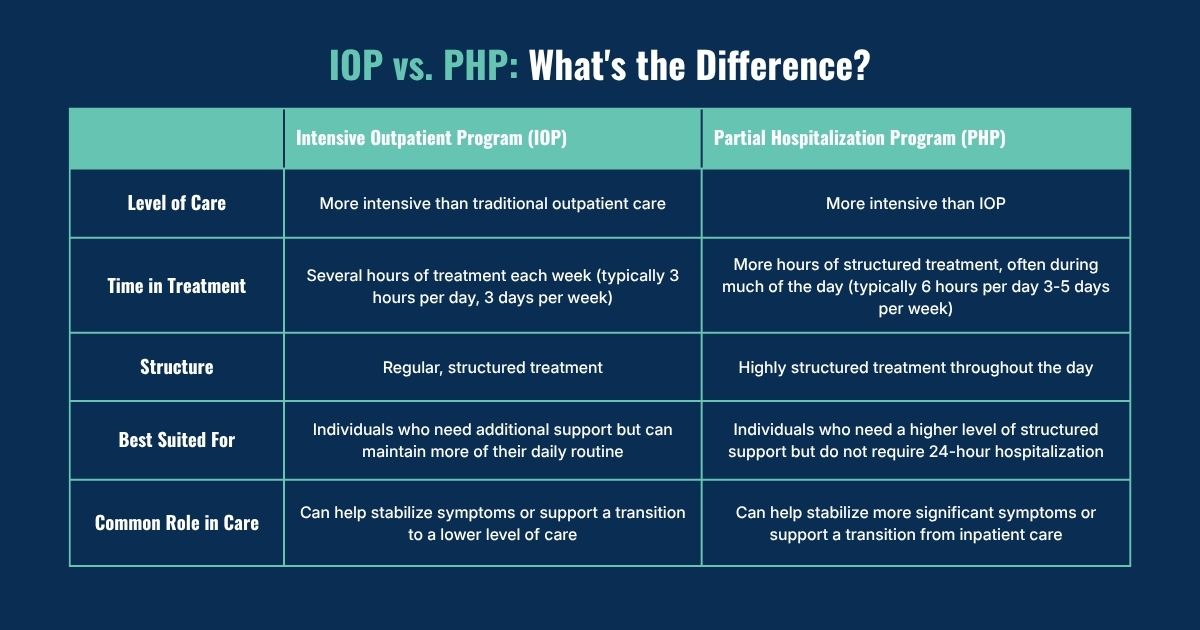
Both Intensive Outpatient Program (IOP) and Partial Hospitalization Programs (PHP) provide more support than traditional outpatient therapy, while allowing individuals to continue living at home. The main difference is the intensity and amount of support provided.
Better understanding these options can make it easier to have a conversation with a primary care provider, mental healthcare professional, or a loved one about what comes next.
An Intensive Outpatient Program, or IOP, provides structured mental health treatment for individuals who need more support than traditional outpatient therapy but do not need the level of care provided by a hospital or partial hospitalization program.
IOP allows individuals to receive several hours of treatment each week while continuing to live at home and maintain many of their usual responsibilities, such as work, school, family commitments, and other activities.
IOP may be appropriate for someone who:
Treatment may include a combination of group therapy, individual therapy, psychiatric services, medication management, skills development, and other services based on the individual’s needs and treatment plan.
A Partial Hospitalization Program, or PHP, is a more intensive level of outpatient mental health care. Despite the name, partial hospitalization does not mean that someone stays overnight in a hospital. Participants attend treatment during the day and return home when programming ends.
PHP is designed for individuals who need a significant amount of structured support but do not require 24-hour inpatient hospitalization.
PHP may be appropriate for someone who:
Because PHP provides more hours of treatment and structure, it can offer more frequent opportunities to work on symptoms, coping strategies, medication needs, and other challenges affecting a person’s mental health.
The easiest way to think about IOP and PHP is in terms of intensity.
Mental health treatment isn’t one-size-fits-all. Someone may need different levels of support at different points in their recovery.
For example, a person might move through several levels of care:
Inpatient care → PHP → IOP → Traditional outpatient care
Not everyone will need every level, and people don’t necessarily move through them in a particular order.
The goal is to provide the right amount of support at the right time. Someone who needs more structure may benefit from PHP. As symptoms stabilize and greater independence becomes possible, IOP or traditional outpatient care may be appropriate.
Likewise, someone receiving outpatient therapy may need additional support during a particularly difficult period and transition temporarily into IOP or PHP.
If you’re considering care for yourself or a loved one, you don’t have to figure this out on your own.
A mental health professional can help assess current symptoms, daily functioning, treatment history, safety concerns, and other factors to determine what level of care may be appropriate.
A referral to IOP or PHP does not mean someone will need that level of care indefinitely. These programs are often part of a broader treatment plan designed to help people become more stable and eventually transition to a level of care that better fits their needs.
It’s normal to feel unsure about what kind of mental health care you or your loved one needs. You may know that weekly therapy isn’t providing enough support, but you’re not sure what comes next. Or you may be transitioning out of a hospital or other intensive setting and need to understand your options.
Starting the conversation is an important first step.
A mental health provider can help you understand the available levels of care and determine what makes sense based on the individual’s current needs. The goal isn’t simply to find the most intensive program available—it’s to find the level of support that is appropriate for the person, at that point in their care.
At CSG, we offer a range of behavioral health services designed to meet people at different points in their mental health journey. If you have questions about IOP, PHP, or other treatment options, our team can help you understand your options and determine where to begin.
You don’t have to know the right level of care before asking for help. Contact us today to learn more about our services and find out how CSG can help you get started finding the support you need.